Showing posts with label action film. Show all posts

9/14/15

HARDCORE: Video World Premiere Post-Screening QA with IIya Naishuller, Sharlto Copley, Timur Bekmambetov,


Hardcore was extremely well-received at the world premiere at Midnight Madness. The film pushed the boundaries of storytelling with the unique style of using only the first person point of view. We, the audience, became this amazing action star. Jumping from helicopters, fighting armed assassins, running for our lives. Here is the complete introduction and post-screening Q&A with director writer IIya Naishuller, actor Sharlto Copley and producer Timur Bakmambetov, moderated by programmer Colin Geddes.

HARDCORE screens:
Mon, Sept 14, 4:15 PM SCOTIABANK
Fri, Sept 18, 1:00 PM SCOTIABANK

9/13/15

HARDCORE: Video World Premiere Interviews with IIya Naishuller, Sharlto Copley, Timur Bekmambetov,


Hardcore had its world premiere last night at Midnight Madness and Robert A. Mitchell had to elbow, punch, jump over a flaming car and drop out of a helicopter to get the interviews with IIya Naishuller, who wrote and directed this amazing new POV action film. He also spoke with actor Sharlto Copley and producer Timur Bekmambetov.


HARDCORE screens:
Mon, Sept 14, 4:15 PM SCOTIABANK
Fri, Sept 18, 1:00 PM SCOTIABANK

8/22/13

FESTIVAL SALUTES 25 CHILLING YEARS OF MIDNIGHT MADNESS: ROCKING, SHOCKING AND SAVAGING THE SENSES


The Toronto International Film Festival® celebrates 25 years of Midnight Madness with a murderers’ row of wild cinematic thrills. Programmed by Colin Geddes, the international lineup aims right for the jugular with everything from an extraterrestrial gore-thriller and sinister sex-comedy, to an Asian exotic horror film and a visually-stunning reinvention of the Italian cannibal genre. 

"Since its 1988 launch, the Midnight Madness programme emerged as a touchstone of cinematic shock, satiating the adventurous palate of bloodthirsty cinephiles from all over the world," said Geddes, International Programmer for the Festival. "When the witching hour strikes and the human brain starts slipping into dream mode, the Ryerson Theatre will once again serve up a feast of phantasmagorical characters and jaw-dropping scenes, playing host to bizarre biological monstrosities, ruthless dominatrix gangs, paranormal mirrors, and the hijinks of supernatural cheerleaders."

The programme presents films from Midnight Madness alumni Hitoshi Matsumoto, Eli Roth and Sion Sono, as well as the debut feature of Hong Kong pop singer Juno Mak.
 

The 38th Toronto International Film Festival runs from September 5 to 15, 2013. 


Midnight Madness Opening Night Film
All Cheerleaders Die 

Lucky McKee, Chris Sivertson, USA, World Premiere
When tragedy rocks Blackfoot High, rebellious outsider Mäddy Killian shocks the student body by joining the cheerleading squad. This decision drives a rift between Mäddy and her ex-girlfriend Leena Miller — a loner who claims to practice the dark arts. After a confrontation with the football team, Mäddy and her new cheerleader friends are sent on a supernatural roller coaster ride which leaves a path of destruction none of them may be able to escape. 


Derek Lee and Clif Prowse, Canada/USA, World Premiere
Best friends Derek and Clif set out on a trip of a lifetime. Their plan: travel to the ends of the earth, see the world, and live life to the fullest. But the trip soon takes a dark and bloody turn. Just days in, one of the men shows signs of a mysterious affliction which gradually takes over his entire body and being. Now, thousands of miles from home, in a foreign land, they must race to uncover the source of his illness before it consumes him completely. Footage of their travels meant to document pleasant memories may now become evidence of one of the most shocking discoveries ever captured on film…and may be their only postcard home.


Joe Begos, USA, World Premiere
Mark Fisher disappeared from his home in a brilliant flash of blue light almost two years ago. His friend Seth Hampton was the last to see him alive. Now a string of grisly, violent murders leads Seth to believe that Mark is back, and something evil is living inside of him. 


Eli Roth, USA, World Premiere 
How far would you go for a cause you believe in? In horror master Eli Roth’s terrifying new film, a group of college students take their humanitarian protest from New York to the Amazon jungle, only to get kidnapped by the native tribe they came to save: a tribe that still practices the ancient rite of cannibalism, and has a healthy appetite for intruders.


Mike Flanagan, USA, World Premiere
Oculus is a spine-chilling supernatural tale of two damaged siblings (Karen Gillan and Brenton Thwaites) who, as children, witnessed their parents' harrowing descent into madness and murder. At long last, brother and sister reunite as adults to expose and destroy the paranormal entity they believe is responsible: the Lasser Glass — a legendary mirror their family once owned. 


Hitoshi Matsumoto, Japan, World Premiere
An ordinary man with an ordinary life joins a mysterious club. The membership lasts for one year only and there is one rule: no cancellation under any circumstance. The man enters into an entirely new and exciting world which he has never before experienced. 


Juno Mak, Hong Kong, North American Premiere
Juno Mak’s debut feature Rigor Mortis is an eerie and chilling, contemporary action- and special effects-laden homage to the classic Chinese vampire movies of the 1980s. Starring Chin Siu-Ho, Kara Wai, Anthony Chan, Lo Hoi Pang and Richard Ng. 


The Station (Blutgletscher

Marvin Kren, Austria, World Premiere
At a climate research station in the Alps, the scientists are stunned as the nearby melting glacier is leaking a red liquid. It quickly turns to be very special juice — with unexpected genetic effects on the local wildlife.


Sion Sono, Japan, North American Premiere
Two men, Muto and Ikegami, hate each other. Muto desperately wants to help his daughter Mitsuko star in a movie. Meanwhile, Ikegami falls in love with Mitsuko, knowing that she's the daughter of his foe. Hirata, a filmmaker, and Koji, a young movie-lover, get dragged into this complicated situation that heads into an unexpected direction. 


Alex de la Iglesia, Spain/France, World Premiere 
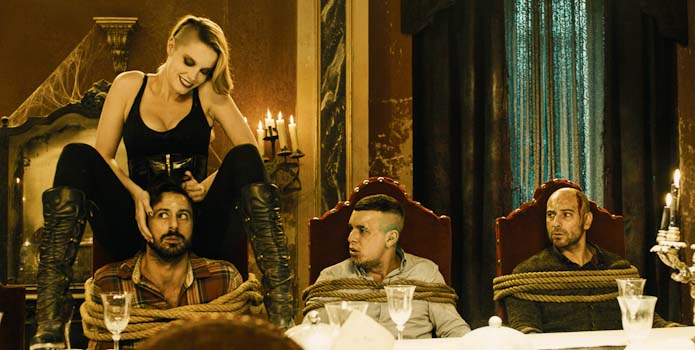
Desperate dad José and his friends run from a coven of witches hell-bent on their souls and on the 25,000 wedding rings the guys stole from a Cash-for-Gold shop in a desperate attempt to escape their lives of wife troubles. Witching & Bitching marks the seventh film by cult-favourite Spanish genre specialist Alex de la Iglesia (The Last Circus) to be screened at TIFF.


Tickets to screenings for this programme will be available for individual purchase as well as through the
Midnight Madness Pack, which includes all 10 screenings for $176, or $113 for students and seniors. Purchase Festival ticket packages online 24 hours a day at tiff.net/festival, by phone Monday to Friday from 10 a.m. to 7 p.m. ET at 416.599.TIFF or 1.888.599.8433, or visit the box office in person from 10 a.m. to 10 p.m. ET at TIFF Bell Lightbox, Reitman Square, 350 King Street West, until August 19.

About TIFF
TIFF is a charitable cultural organization whose mission is to transform the way people see the world through film. An international leader in film culture, TIFF projects include the annual Toronto International Film Festival in September; TIFF Bell Lightbox, which features five cinemas, major exhibitions, and learning and entertainment facilities; and innovative national distribution program Film Circuit. The organization generates an annual economic impact of $189 million CAD. TIFF Bell Lightbox is generously supported by contributors including Founding Sponsor Bell, the Province of Ontario, the Government of Canada, the City of Toronto, the Reitman family (Ivan Reitman, Agi Mandel and Susan Michaels), The Daniels Corporation and RBC. For more information, visit tiff.net.

The Toronto International Film Festival is generously supported by Lead Sponsor Bell, Major Sponsors RBC, L'Oréal Paris, Visa and Audi, and Major Supporters the Government of Ontario, Telefilm Canada and the City of Toronto.

The Midnight Madness programme is made possible through the generous sponsorship of Cineplex Entertainment and Space.

9/14/11

SLEEPLESS NIGHT: A French Thriller Appeteaser


Here's a little sampler plate of Jean-Pierre Melville's films to whet the appetite for Sleepless Night.


Tues. Sept. 13th, 11:59pm RYERSON
Weds. Sept. 14th. 3:00pm AMC 1
Fri. Sept. 16th, 9:45pm SCOTIABANK THEATRE 11

9/13/11

Spotlight on SLEEPLESS NIGHT director Frédéric Jardin


 Frédéric Jardin, director of Sleepless Night
Looks to keep you up all night! 
Moments ago, I spoke with French director Frédéric Jardin about his new film action noir film Sleepless Night - which premieres tonight at Midnight Madness! Check out the full interview below!

Several French horror directors at Midnight Madness say that it’s quite tough to make genre films in France. How is the climate for action films, and how did you pitch this film?

It’s very hard to raise money for action films. My producer Marco, produced A Prophet and with the success of that, it won a prize in Cannes, so it was easier for him. This was a 3 million euro film, so it’s not very expensive film.
Tell us about how the project came together - your inspiration, your key collaborators, how you found your star in Tommer. 

At the very beginning I wanted to do an action film, so I was thinking about paternity - so that was the very beginning when I started writing - I wanted to mix action and paternity - I was thinking of an actor who was physical and emotional - Tommer moves really well, there was a lot of emotion when he ran. It’s not a just an action film, I needed the actor to feel emotion all the time, for the whole movie... this was a challenge. And Tommer loved the script.
What was the moment when you knew the film would happen?

When we found a distributor - Bacfilms - our french distributor - that was main the thing. We got some money from several TV stations, but getting this distributor was the moment that the film would be made.
What’s the biggest difference with this film from your other films?
They were more comedy, even through they are dark comedy - this is more film noir, it’s a real thriller, and a dark one. Even though there is dramatic irony, it is more serious and darker - it’s about relationship between father and son, paternity, so I wanted it to be very serious - even though it features a chase on the surface, above all it’s about this relationship.
You mentioned to me that you avoided outside influences as much as possible when creating this movie to keep your vision pure. How did you enforce that on yourself, and what did you do to cultivate your own style?

I decided for this film - to film it like a documentary - camera on the shoulder, and extremely realistic in action. I didn’t want to film the violence graphically - but instead very realistic dirty violence, with sweat- and you feel the people are very exhausted by this crazy night, and I wanted all of these things to be very realistic and that’s the style at the end. I wanted something very frenetic. Because the main character doesn’t have any time to save his son.

Making movies can be crazy and unpredictable; What was the strangest obstacle you dealt with during the shoot?
Not so much, the film was very well planned, and was always inside, and while we had a crowd - I wanted it to be very realistic but everything was planned at the same time. It seems like a contradiction but it goes in the same direction. We planned the chaos, which is quite hard usually!
What was the best lesson that making this film taught you?

I learned everything with this film, it was very new for me, and that’s a new direction that I want to continue to work in.
Writing is very cathartic, in that you can write about how you’d like to react to a situation- and that’s what I love about it. However, if you were put in a similar situation as your film’s character Vincent, how would you honestly react?
Hm. I would do the same thing as him! You know it’s hard to say, I can’t answer that - I am very close to the character, I don’t want to give it away, you to have to see the movie. 
What are some of your favorite films, and what other genres are you interested in working in?

Work in other Genres? Yeah why not - I am not crazy about the typical horror film, but every director should be interested by all genres. Some of my favorite films are- Nicholas Winding Refn’s Pusher Trilogy, Joon-Ho Bong's films Memories of Murder, Mother, and The Host. And also Hong Jin Na’s Chaser.  I love TV series like Breaking Bad, and Sopranos
**
Be sure to see for yourself EXACTLY what  bone-cracking extremes Frédéric Jardin would execute to save his son, were he facing the depraved gangsters from Sleepless Night!

Tues. Sept. 13th, 11:59pm RYERSON
Weds. Sept. 14th. 3:00pm AMC 1
Fri. Sept. 16th, 9:45pm SCOTIABANK THEATRE 11

9/1/11

Interview with Gareth Evans Director of THE RAID


The Raid has the distinction of being the first Indonesian film to ever screen at Midnight Madness, it also opens the programme. The film promises to deliver on the action as well as introduce the world to a new action star, his name Iko Uwais. I recently had the opportunity to talk with The Raid's director, Gareth Evans.


You were born and studied in Wales, I'm quite curious how you went from the United Kingdom to directing films in Indonesia. Could you tell me a bit about the journey?
After coming out of University I found myself stuck doing a 9-5 job in Wales for years. Shamefully my drive to go out there and make films was limited to just a few shorts (all of which are too terrible to share online) I would never begrudge the industry for lack of opportunities, cos I don't feel I did enough to find them myself. So around 5 years into my time at the company I had the urge to make a feature, I wrote Footsteps as something I could do on a limited budget (around $10,000) after trying and failing to get a business grant for the film I decided to just take out a personal loan and self-fund it and deal with the debt later. Thankfully my boss at the time was kind enough to let me take a month off to go ahead and make it, so repaying the budget was an affordable cost. The film didn't exactly set the world alight but it was a defining moment for me and I knew I had to pursue film more aggressively than I had before.
How that ended with me in Indonesia is surprisingly straight forward. My wife (who is now also my boss) is Indonesian and she had been pushing my name and the dvd of my film to anyone she knew back home. Luckily for me one of those people was Christine Hakim a hugely talented and respected actress and producer. She was putting together a series of documentaries to be made about different elements of Indonesian culture, each directed by an outsider. Due to my interest in martial arts cinema I was brought in to direct the episode on Pencak Silat. So I left the UK went to Indonesia to work on the documentary for 6 months and by the time I was done I found a love for living in Jakarta, an obsession with a martial art discipline I had never seen before, a ton of story ideas from the research I'd gathered and just to top it off --a leading man in Iko Uwais who I'd met as a student of one of the masters I'd been following.

2) I have been hearing that your lead actor Iko Uwais is one to watch and is poised to become the next big name in action. What makes him so spectacular? What sets him apart from other action stars?
Iko is like a little brother to me, so it's hard to answer this unbiased and I really hate to kiss his ass but I'd have to say that a large part of his success will come from his genuine likeability and the fact that he's quite a skilled actor not just a screen fighter. He's got a lot of work to do to reach the heights of his superiors, but so long as he continues to focus on each project with the same commitment and dedication that he has shown so far he'll get there soon enough. One of the things that we stole wholesale from Jackie Chan is that he's not afraid to incorporate a certain sense of vulnerability to his fight scenes. When we workshop the choreography we always look to include moments where we can see that the hero is in genuine danger, isn't always in control of the fight and could potentially lose. I feel audiences relate to "broken" heros much more than they do to undefeatable killing machines. On a personal level, why I like to work with Iko so much is that he's stayed a humble person throughout all of this. We've worked together now on a documentary and two feature films and even though he's gone from being an unknown driver for a phone company to a global martial arts star his personality hasn't changed. He hasn't let the fame side of the industry get the better of him. When you spend close to a year on a project, it helps a lot if the person you spend the most time with isn't a total dick. Luckily for Iko, I'm only a dick half the time.
3) How did you and Iko meet?
We met while I was shooting the documentary. He was a student of one of the masters we were following (Pak H. Achmad Bunawar from Silat Tiga Berantai) and during a practice session in pre-production we realised immediately that he had a certain aura about him. He stood out from the 20 or so students practicing with him, so I said to Maya that we should keep in touch with him and see if we could set up a film or a tv series to showcase his skills. What followed was a really badly shot and edited test fight (my first experience to shoot a fight scene) but one that showed Iko had potential. I told him at the time that I would come back to Jakarta one day and that I'd like to make a film with him in the lead. He presumed I was full of shit, but a few months later we came back told him to quit his job once his contract was up and we went ahead and made Merantau.

4) Who was your fight choreographer on the film? What styles of martial arts can we expect to see in THE RAID?

For The Raid the martial arts choreography was by Iko Uwais and Yayan Ruhian (also from Merantau - he played Eric). Meanwhile I oversaw the design adding some throws, increasing some of the aggression on the knife work and handling the stunt design and gunplay. Anyone who saw Merantau will hopefully recognise a similar signature in how we shoot our fight scenes with some long takes but we've also changed things up quite a bit to increase the pace of the action. The fighting style is a lot more brutal and direct in comparison. This is largely due to the change in psychology between the two protagonists. In Merantau, Iko's character was for the most part trying to avoid the fights, a simple flurry of light hits before making an attempt to escape. In The Raid however, the whole concept and situation makes it a kill or be killed environment. We couldn't get away with light hits and a push anymore--each attacker had to be left incapable of standing up again so its a lot of bone-breaking, knee-cap separating and head smashing.

On a technical level we continue to explore using silat in a practical way, you won't find any traditional posturing here, but a real life application of moves, locks and throws. Other than silat, the casting of Joe Taslim (a national Judo champion) as the leader of the swat team, Jaka, led to us incorporating some Judo techniques to give a different flavour to the action and give him an opportunity to shine also. Joe's got a huge amount of potential to break out as a big star, he has a huge screen presence and his dedication on and off camera has made it an absolute joy to work with him. But Yayan Ruhian as Mad Dog for me owns the show, his fight scenes are savage with fast attacks, showing his ability to adapt mixing complex techniques with raw aggression. I can't wait to see how the audience reacts when his first fight plays out.


5) The Raid marks the first Indonesian film to screen at Midnight Madness, can you describe what the Indonesian film industry is like? What are some of the advantages and challenges to shooting in Indonesia?

I think it's much the same as any industry--lots of very talented filmmakers struggling to get budgets to make some really great films offset by some truly terrible films that get churned out by the studio system and flood the market. The advantages are many - we have some stunning unique locations here and a rich history that can be mined for some fascinating stories. Meanwhile I've been incredibly lucky to surround myself with a crew that absolutely will not stop until we are done with the shoot. We've had some pretty punishing hours to get this film wrapped, but they've supported me throughout and given everything. When it comes to challenges, being more specific to me in my field I'd say that when it comes to action, admittedly we're in our infancy our experiences are limited but we're growing with each film. With our films we're often designing stunts that are much larger in scope than is usually performed or practiced by local stunt teams. Much of their work comes from television with stunts limited due to budget, and then suddenly they're meeting us in pre-pro and I'm showing them crudely drawn storyboards of someone jumping out of a window, dropping two-storeys and bouncing off a concrete window ledge before landing safely into a steel balcony. Naturally it takes time to adjust and work out the logistics and how to execute the shots but we get there eventually.


6) The learning curve for directing action films is pretty steep, what films and filmmakers did you study to find your own style for shooting?

Ever since I was a kid my Dad pretty much shaped my film going experiences and introduced me to the whole spectrum of action cinema. He was the one who first showed me Seven Samurai and Ran, but then he also showed me The Wild Bunch, The Getaway, Armour of God and Police Story. This is back in the days of VHS rentals and some of those films were hard to come by, especially in Wales. He really was a huge film buff, but never a film snob. If it kicked ass and was entertaining it was just as important as anything considered "critically acclaimed".

When it came time to design the action sequences for The Raid I knew we had to step up in terms of quality from Merantau, we had to show our growth from that film and prove ourselves. I've been lucky enough to build a friendship with Mike Leeder who gave me some of the most important constructive criticism that helped me find a better balance between my fondness for wide angle long takes while also maintaining the energy of both the scene and the performers. On Merantau I burnt everyone out--the shots were just too long and too frequent. For almost every shot in that final cut of the film you're seeing take number 20+ and by then everyone is wasted. So by planning those long shots a little better and not having quite so many of them this time round I was able to get a more focused performance from Iko and the fighters, with more accuracy and a higher energy. We don't undercrank in camera, we always shoot at 24fps so those hits have to come in fast and hard.
For influences I'd go back to my HKL DVD of The Young Master and see Jackie Chan's editing of Whang In-Sik's intro fight, Project A Part 2 meanwhile contains for me some of Jackie's finest work. Undisputed 3 (a criminally underrated action film) was also a major influence for it's fluid editing and camerawork. For the gunplay I borrowed heavily from John Woo and Sam Peckinpah in terms of style while looking to John Carpenter's Assault on Precinct 13, Escape From New York and Walter Hill's The Warriors and Southern Comfort to try and get that feeling of an unrelenting, claustrophobic attack. Merantau was very serious and took a while to get going, but on this one I wanted to have fun with it and cut to the chase faster while playing around with our camerawork, editing and action design. Hopefully it provides enough thrills to keep the audience on edge throughout.

7) You directed a short entitled Samurai Monogatari filmed with actors speaking Japanese and all of your features have been made in Indonesia, even with the use of translators--conveying your ideas on set has to be sometimes difficult, is there a technique you have developed to overcome the language barrier?

In pre-production I always show my entire cast and crew some films so they get a sense of the style we're going for--I try to pick films that apply for each department whether its art, lighting, camerawork or performance. It's a helpful step and one that transcends language barriers to make sure everyone is on the same wavelength going in.

For both Merantau and The Raid I've been lucky enough to have a core team and dept heads that all speak fluent English. So many commercials are shot here with Australian directors that it seems quite common-place in the industry. On Merantau I was lazy and relied heavily on my team being able to speak English, but since then I've started to learn Indonesian from the crew and while they have mostly taught me ways to insult someone they've also helped me to communicate bi-lingually with the rest of the cast and crew. Learning the language has been hugely important, not just out of respect for the fact that I live and work in their country, but because it's become much easier now for me to judge whether or not the performance is there. I can direct the drama and dialogue with more confidence and know when something is off. On Merantau I'd be clutching to my English script and hover between it and the monitor like I was reading subtitles.
THE RAID screens at 11:59pm Thursday Sept, 8th at Ryerson and 12:15pm Saturday Sept. 10th at AMC 2